How GWS maps BDL types into the OpenAPI description
GWS maps Genero BDL types to JSON schema objects in the OpenAPI description. The mapping depends on the content type and whether the data type is named or anonymous.
Anonymous types
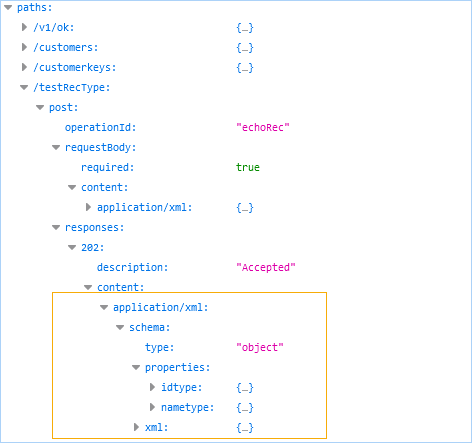
When an operation uses an anonymous type, or when the content type is set to
application/xml, the GWS engine exposes the object structure directly in the
OpenAPI description. The properties appear inline within the schema of the request
or response body.
This mapping is used when the type is not explicitly named in your BDL code or when XML content is required.
Named types
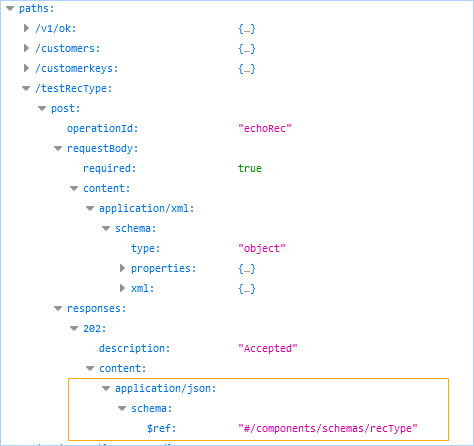
When an operation uses a named type and the content type is
application/json, the GWS engine represents the object using a
$ref. The reference points to a definition in the
components/schemas section of the OpenAPI description.
In this documentation, a named type refers to a schema that is defined once and
reused through a $ref reference. This follows the JSON Schema pattern used by
OpenAPI. An anonymous type refers to an inline schema whose properties are written
directly inside the schema element. Anonymous types cannot be reused, while named
types appear under components/schemas and can be referenced by multiple operations.
This reuse model keeps the OpenAPI description concise and ensures that changes to a named type are reflected consistently across all operations that reference it.
Parameters
Parameters defined with WSHeader, WSQuery, or
WSCookie attributes are mapped to the corresponding OpenAPI parameter entries.
These parameters are independent of the $ref mechanism and are always described
inline.
Error handling
Error types defined with the WSError attribute follow the same mapping rules as
named or anonymous types, depending on their content type. The generated OpenAPI description shows
error responses in the responses section of each operation.