Version access modes
Specify how clients access service versions in REST operations.
A web service information
record may include the WSVersionMode attribute, which
defines how clients access versioned operations. The mode applies to all operations in the REST
service.
The available version modes are:
uriheaderquery
In this example, WSVersionMode is set to "query", which applies
the mode to the entire service:
PUBLIC DEFINE myInfo RECORD ATTRIBUTES(WSInfo, WSVersion = "v3",
                                      WSVersionMode = "query")
   title STRING
   # ...
END RECORD
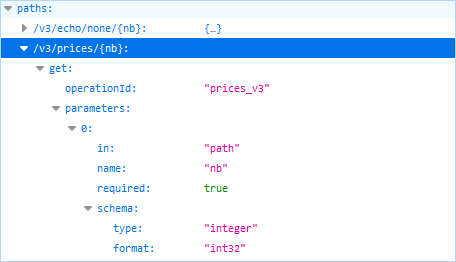
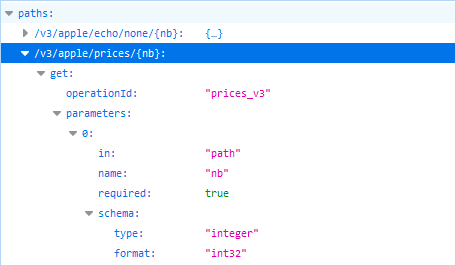
Default version mode (URI)
If WSVersionMode is not set, or set to "uri", GWS adds the
version directly to the resource path.
The OpenAPI document reflects this by prefixing the resource path with the version.
The following figures show examples for a service with one resource and for a service with multiple resources.
Query mode
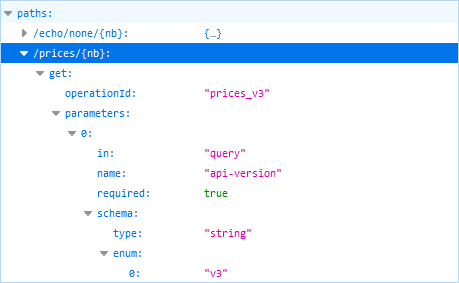
If WSVersionMode is set to "query", GWS adds the
api-version query parameter to the OpenAPI description.
- The client must send the required version using this query parameter.
- The OpenAPI document includes the parameter definition using the
enumkeyword. -
GWS appends the query string automatically in requests, for example:
?api-version=v3
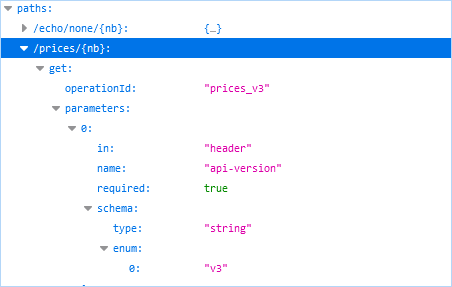
Header mode
If WSVersionMode is set to "header", GWS adds the
api-version HTTP header parameter to the OpenAPI description.
- The client must include this header in each request.
- The OpenAPI document includes the header definition using the
enumkeyword.