JSONAdditionalProperties
Allows a record to accept JSON properties not explicitly listed in its schema definition.
Syntax
JSONAdditionalProperties = { true | false } JSONAdditionalProperties is an optional attribute. Default value is true.
This serializer-specific attribute is supported only by json.Serializer and does not work with util.JSON.
Usage
Set JSONAdditionalProperties on a record, dictionary type, or user-defined type to control whether it accepts properties
not listed in its definition. The default is true: additional properties are accepted.
JSONAdditionalProperties represents the additionalProperties
keyword in the OpenAPI JSON schema specification.
Example 1: using JSONAdditionalProperties
This example shows the three ways to set JSONAdditionalProperties:
MyRecordsets it tofalse: the GWS engine rejects any JSON property not defined in the record.MyArraysets it explicitly totrue: additional properties are accepted.MyComplexTypeomits the value, which defaults totrue: additional properties are accepted.
TYPE MyRecord RECORD ATTRIBUTE(JSONAdditionalProperties="false")
  a,b INTEGER  # extra JSON properties rejected
END RECORD

TYPE MyArray DYNAMIC ARRAY OF RECORD ATTRIBUTE(JSONAdditionalProperties = "true")
   a,b INTEGER  # extra JSON properties accepted (explicit true)
END RECORD

TYPE MyComplexType RECORD ATTRIBUTE(JSONAdditionalProperties)
  a,b INTEGER  # extra JSON properties accepted (no value = default true)
END RECORD
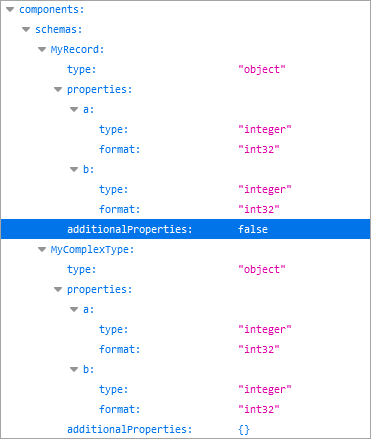
The GWS engine exposes the additionalProperties property in the OpenAPI schema
for records defined with JSONAdditionalProperties. In the following schema,
MyRecord rejects additional properties and MyComplexType accepts
them. Open curly braces ({}) denote true.
Example 2: capturing additional properties
With JSONAdditionalProperties=true on the record alone, you can accept unknown
JSON properties without error, but you won't be able to reference them in your code.
If you need to reference them in your code, add a DICTIONARY field also marked
with JSONAdditionalProperties. Any JSON property not matched to a named field
goes into that dictionary, with the property name as the key.
Declare the dictionary as OF STRING to capture additional properties as string
values:
TYPE MyStoredTypeString RECORD ATTRIBUTE(JSONAdditionalProperties)
  a,b INTEGER,
  p DICTIONARY ATTRIBUTE(JSONAdditionalProperties) OF STRING
END RECORD
Declare the dictionary as OF RECORD to capture structured additional
properties:
TYPE MyStoredTypeRecord RECORD ATTRIBUTE(JSONAdditionalProperties)
  a,b STRING,
  p DICTIONARY ATTRIBUTE(JSONAdditionalProperties) OF RECORD
    d,e INTEGER
  END RECORD
END RECORD
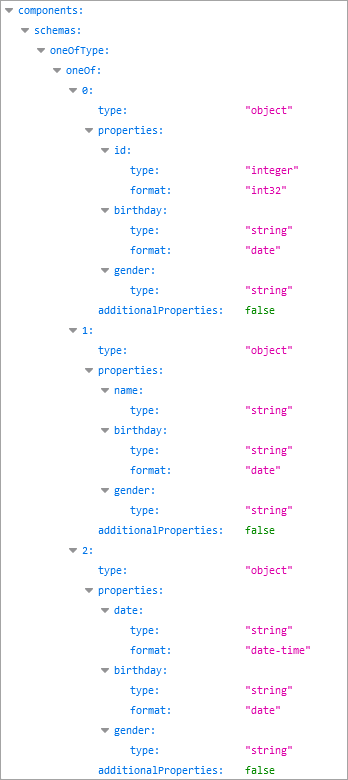
Example 3: using JSONOneOf with JSONAdditionalProperties
This example shows how JSONAdditionalProperties="false" makes
JSONOneOf work when sub-records share common fields (birthday
and gender):
- Without the attribute: all sub-record schemas accept any request, so
oneOfcannot resolve. - With the attribute set to false: a sub-record is rejected if the request contains a property it does not define; only the variant whose fields match the request remains valid.
For the JSONRequired alternative, see Example 2: using JSONOneOf with JSONRequired.
# JSONAdditionalProperties=false is mandatory on each sub-record
# Otherwise all schemas are valid and oneOf cannot resolve
TYPE oneOfType RECORD ATTRIBUTE(JSONOneOf)
    _selector INTEGER ATTRIBUTE(JSONSelector),
    accountById RECORD ATTRIBUTE(JSONAdditionalProperties="false")    # variant 1: look up by id
        id INTEGER,
        birthday DATE,
        gender STRING
    END RECORD,
    accountByname RECORD ATTRIBUTE(JSONAdditionalProperties="false")  # variant 2: look up by name
        name STRING,
        birthday DATE,
        gender STRING
    END RECORD,
    accountBydate RECORD ATTRIBUTE(JSONAdditionalProperties="false")  # variant 3: look up by date
        date DATETIME YEAR TO SECOND,
        birthday DATE,
        gender STRING
    END RECORD
END RECORD


FUNCTION echoOneOfType(
    in oneOfType)
    ATTRIBUTE(WSPost, WSPath = "/echoOneOfType")
    RETURNS(oneOfType)
    DEFINE out oneOfType

    LET out = in

    DISPLAY out._selector

    CASE
        WHEN out._selector = 2
            DISPLAY "schema 1, id: ", out.accountById.id

        WHEN out._selector = 3
            DISPLAY "schema 2, name: ", out.accountByname.name

        WHEN out._selector = 4
            DISPLAY "schema 3, date: ", out.accountBydate.date
    END CASE

    RETURN out
END FUNCTION
The GWS engine generates an OpenAPI schema with oneOf and
additionalProperties set to false.